
Carrier allocation management should be a strategic part of your ocean freight operations. In practice, for most logistics teams, it turns into a second job: one that runs entirely on spreadsheets, copy-pasting, and instinct.
If you’re responsible for the performance of your ocean freight operations, you’ve probably seen the pattern. Your team is juggling multiple spreadsheets, reconciling data that’s already stale by the time it’s compiled, and making vessel selection calls without a complete picture. The contracts are signed. The rates are negotiated. But turning those commitments into actual operational value? That’s where execution breaks down.
This article walks through the core challenges that make carrier allocation management harder than it needs to be, and the strategies to fix them.
Key Takeaways
- Carrier allocation management is the process of tracking and executing your contracted space commitments with ocean carriers.
- Most logistics teams rely on manual spreadsheet tracking to follow their allocation consumption, creating data lag, entry errors, and an inability to make confident vessel selection decisions in real time.
- Choosing the optimal carrier for each shipment requires balancing allocation consumption, freight costs, transit times, and CO₂ emissions simultaneously, which is too complex to do manually at scale.
- Real-time visibility, cross-entity coordination, and AI-assisted vessel selection are the three levers that turn allocation management from an operational burden into a strategic advantage.
- BuyCo is an Ocean Freight Platform that centralizes all dimensions of carrier allocation management into a single system, eliminating manual work and optimizing every vessel selection automatically.
What Is Carrier Allocation Management (and Why Is It So Hard)?
When you sign an ocean freight contract as a BCO, you commit to a Minimum Quantity Commitment: a guaranteed volume of TEUs over the contract year, typically broken down by trade lane. In exchange, you get negotiated rates and secured space.
Carrier allocation management is the process of tracking and executing against those commitments, booking by booking, week by week.
Done well, it means your team always knows:
- How much contracted space has been used on each carrier and trade lane
- How much remains available
- Whether they’re on track to fulfill your MQC by contract end
Done poorly, which is the reality for most teams, it means constant work from incomplete data, vessel selection decisions made without the full picture, and hours spent on administrative tasks that add no value.
The root cause is almost always the same: the tools and workflows weren’t built for this.racking software addresses these pain points by providing a centralized, automated, and intelligent view of your entire container lifecycle.
The Two Problems Worth Solving
1. The Manual Workload Is Unsustainable
Ask any logistics operations team how they track allocation across carriers, and the answer is usually some version of: “We update a spreadsheet.”
The problem isn’t that your team lacks rigor. It’s that the workflow itself is fragile. Keeping spreadsheets up to date across dozens of weekly bookings, multiple trade lanes, and several carriers is a time-consuming task in itself, before even factoring in the inevitable back-and-forth to chase missing information or correct entries. Manual data consolidation creates a constant lag between what’s actually happening and what your team can see, and when the data isn’t current, there’s no way to be certain your team is choosing the most optimized carrier for each shipment.
If you’re managing freight across multiple business units or working with external freight forwarders and suppliers, the complexity multiplies further. One team may be underutilizing space on a lane where another is scrambling. Suppliers book whatever carrier is most convenient for them. Without a unified view, none of this surfaces until it’s too late to act.
2. Vessel Selection Is More Complex Than It Looks
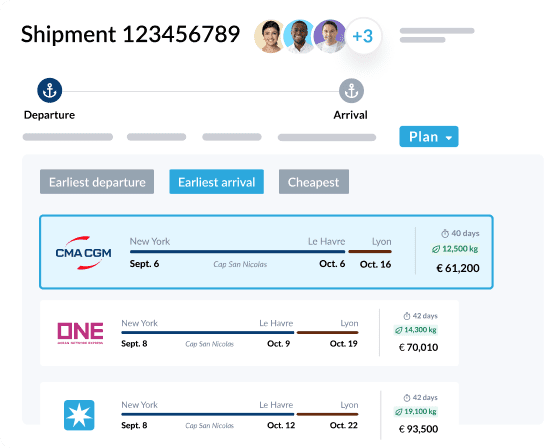
Choosing the right vessel for each booking isn’t just a matter of picking whoever has space available. To make the genuinely optimal choice, your team needs to weigh several variables simultaneously:
- Which carriers still have available allocation under your contracts
- Freight costs for each option
- Transit times and schedule reliability
- CO₂ emissions, if sustainability is part of your procurement criteria
In practice, most teams don’t have the time or the data visibility to evaluate all of these for every single shipment. So they default to familiar carriers, or whoever has space, or the option that’s easiest to book in the moment. The result is vessel selection that’s functional but not optimized, and over hundreds of bookings a year, that gap adds up.
5 Strategies to Fix It
Strategy 1: Centralize Allocation Visibility
The most critical step in optimizing your carrier allocation is knowing exactly where you stand, in real time and across all your carriers.
The traditional approach is a significant drain on your team’s time:
- Manually reporting carrier, volume, dates, origins and destinations of your shipments into spreadsheets
- Working with snapshots that are already out of date by the time they’re compiled
- Making booking decisions based on incomplete, fragmented information
This process creates blind spots that inevitably lead to missed contractual obligations.
Ditch the manual tracking process
Relying on a manual process means your team is always looking at delayed, fragmented snapshots of your allocation standing, never the full picture. The solution is a single platform that pulls commitment data across all active contracts into one place, automatically. When your team doesn’t have to chase data, they can actually use it.
Track at the right granularity
Global-level visibility isn’t enough. To stay ahead of your MQCs, your team needs the ability to drill down by:
- Trade lane
- Week or month
- Business unit or entity
Flexible tracking at every level is what separates proactive allocation management from reactive firefighting.
Strategy 2: Monitor Consumption in Real Time
When allocation consumption updates the moment a shipment is booked, your team never has to guess where things stand. With live consumption data, decisions are based on what’s happening now, not what happened last week.
That visibility becomes especially critical when disruptions occur, and in ocean freight, they always do:
- Blank sailings announced with little notice
- Port strikes that disrupt entire trade lanes
- Schedule rollovers that impact multiple bookings
With real-time data, your team can immediately identify which carriers still have available allocation at the best price.
Strategy 3: Break Down Internal Silos
For BCOs managing multiple business units, the allocation problem compounds. When teams can’t see each other’s booking activity, the result is predictable:
- Team A overshoots its allocation on Asia-Europe
- Team B underutilizes its contracted space on the exact same trade lane
- Neither team knows what the other is doing
This is the silo effect, and it costs more than most logistics leaders realize.
Create a unified view across all entities
A single, aggregate view of allocation consumption across all internal business units allows every team to see the full corporate picture, pooling volume to hit MQCs together instead of creating costly imbalances.
Extend compliance to your external partners
Off-allocation bookings don’t only come from internal teams. The problem also extends to:
- Remote suppliers booking the wrong carrier
- Freight forwarders operating without visibility into your contracts
- Agents making decisions based on their own preferences, not your commitments
Extending your allocation rules to external partners and enforcing them automatically at the point of booking ensures that every shipment made on your behalf stays compliant with your contracts.
Strategy 4: Let AI Handle Carrier Selection
Managing carrier allocation isn’t just about counting remaining TEUs. It’s a multi-variable puzzle that requires balancing:
- Current allocation consumption per carrier and trade lane
- Freight costs
- Transit times
- CO₂ emissions
Expecting operations teams to manually calculate all of these constraints for every single shipment leads to suboptimal vessel selection and contract leakage.
An AI engine can evaluate all available options in seconds, simultaneously weighing every variable. The result:
- Automatic, optimal vessel selection for every shipment
- No manual calculation required from your operations team
- Every booking actively maximizes your contract value while meeting operational and sustainability goals
Strategy 5: Close the Loop With Automated Freight Auditing
The allocation challenge doesn’t end when the cargo is loaded. It extends to the invoice.
When bookings are managed across disconnected tools, your finance team has no reliable way to verify whether a shipment was billed at the contracted rate or at a different rate entirely. Overbilling in ocean freight is more common than most shippers discover, precisely because the audit trail isn’t there to catch it.
When every booking flows through a single platform, you automatically create a complete digital record linking each shipment to its original contract terms, its allocation status at the time of booking, and the rate that should have been applied. When the invoice arrives, reconciliation is immediate. The record is already there.
How BuyCo Puts These Strategies Into Practice
Understanding these strategies is one thing. Having a platform that executes all of them is another.
BuyCo is an Ocean Freight Platform built specifically to address the carrier allocation challenges faced by large-volume BCOs. Rather than patching together spreadsheets and manual calculations, BuyCo centralizes every dimension of allocation management into a single operational system.
Here’s what that looks like in practice:
Real-time visibility: Automated tracking of carrier commitments across all active contracts at the weekly level, with no manual data entry. The moment a shipment is booked, consumption is updated.
AI-powered selection: BuyCo’s smart carrier selection engine connects directly to live schedules and evaluates every booking option against allocation consumption, freight costs, CO₂ emissions, and historical transit times in seconds. The optimal vessel is selected automatically.
Disruption response: When a blank sailing occurs, your team can instantly see available allocation across all carriers and redirect cargo while staying aligned with contracted rates.
Enterprise compliance: Allocation rules are enforced at the point of booking across every internal entity and every external partner. Every shipment, regardless of who makes it, stays compliant with your contracts.
Freight audit: BuyCo pre-calculates costs based on actual volume consumed at contracted rates, before carriers issue invoices. When the invoice arrives, BuyCo’s audit trail makes verification immediate, eliminating overbilling before it becomes a dispute.
The result: logistics teams using BuyCo recover the hours previously lost to manual data entry, and make vessel selection decisions that are genuinely optimized, every time.
Conclusion
The gap between a good ocean freight contract and good ocean freight execution is almost always operational. The rates are negotiated. The space is secured. What determines whether your organization actually captures the value of those contracts is how well your team can track, coordinate, and optimize within them.
The strategies above, centralized visibility, AI-assisted vessel selection, real-time tracking, cross-entity coordination, and automated auditing, each remove a specific friction point from that execution. Together, they replace a process built on manual effort and fragmented data with one that works the way your contracts deserve.
Which of these friction points is costing your team the most right now?
Frequently Asked Questions (FAQ)
What is carrier allocation management in ocean freight? It’s the process of tracking and executing contractual space commitments with ocean carriers. It ensures that weekly bookings stay aligned with the volumes negotiated, by trade lane, time period, and business unit.
What is a Minimum Quantity Commitment (MQC)? An MQC is a contractual volume commitment between a shipper (BCO) and an ocean carrier: a guaranteed minimum number of TEUs to be shipped over a defined period, typically a contract year.
What are the main risks of manual allocation tracking? Manual tracking via spreadsheets creates data lag, human error, and organizational blind spots. The practical result is that teams are always working from an incomplete picture, which leads to under-utilized contracted space, missed MQCs, and vessel selection decisions that aren’t fully optimized.
What is the silo effect in multi-entity freight management? When multiple business units or external partners manage bookings independently, one team can overshoot its allocation on a lane while another underutilizes contracted space on the same lane. Without a unified view, this waste stays invisible, and it’s far more common in large enterprises than most logistics leaders realize.
How does AI improve carrier selection? An AI engine evaluates every booking against live carrier schedules, current allocation consumption, freight costs, CO₂ emissions, and transit times, simultaneously, in seconds. The result is optimal vessel selection every time, without manual calculation or the risk of missing a better available option.
How does automated freight auditing prevent overbilling? By routing all bookings through a single platform, you create a complete digital trail linking each invoice to its original contract terms and the allocation status at the time of booking. When an invoice arrives, verification is immediate, with no spreadsheet archaeology required.