
In container shipping, the Bill of Lading is one of the most important documents in the shipment lifecycle. It also happens to be a document that often requires careful manual checking. Before a Bill of Lading can be approved, shipping teams need to compare it against the Shipping Instructions, verify that key information matches, identify discrepancies and make sure that errors are resolved before they create downstream problems. The process is necessary. But does it need to remain so manual?
The hidden workload behind BL validation
Checking a draft BL against the Shipping Instructions may sound straightforward: compare the two documents and make sure the information matches. In practice, it is more complicated. Bills of Lading can come in different formats depending on the carrier. The same information may be structured or presented differently from one document to another. Cargo descriptions can contain additional nuances, while some fields may be missing or formatted inconsistently.
That means operators cannot simply compare two documents mechanically. They have to read, interpret, compare and decide. And they often have to do it repeatedly. BuyCo’s analysis found that a draft validation involving five containers or fewer can take around 5 to 20 minutes, with several reviews potentially required for a shipment. Multiply that across hundreds or thousands of shipments, and BL validation becomes a significant operational workload.
The bigger risk isn’t just time
The cost of manual validation is not limited to the hours spent checking documents. The other risk is late error discovery. A discrepancy that is identified early can usually be addressed while there is still time to correct the document. A discrepancy discovered late can create operational complications, and, in some cases, financial consequences. A single issue during BL verification can hold up BL issuance, triggering delays in the payment process and ultimately impacting cash flow. So the objective isn’t simply to make BL validation faster. It is to help teams identify potential problems earlier while maintaining the level of control required for an important shipping document.
What if AI could do the first pass?
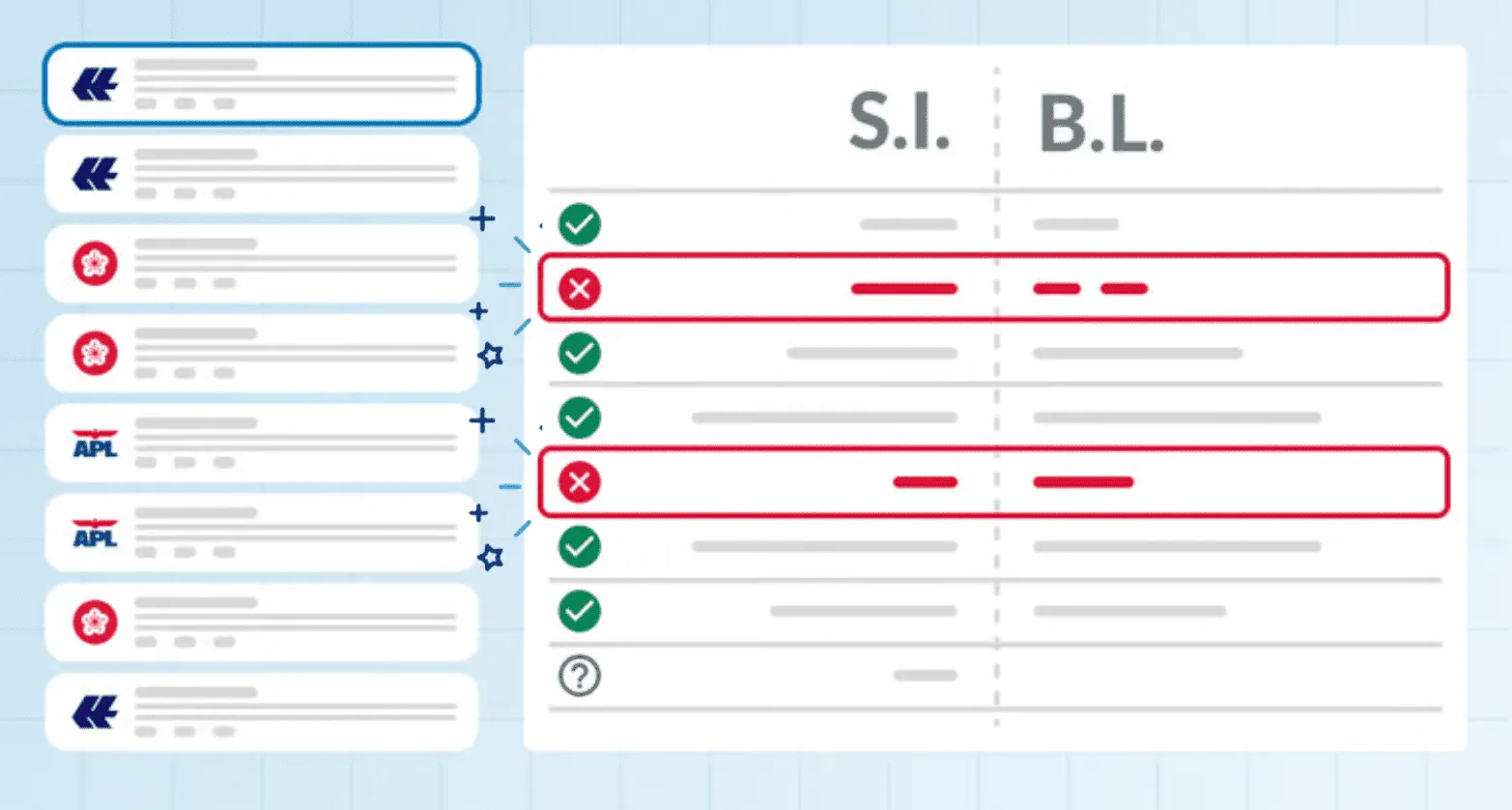
This is where BuyCo Document AI can make a difference. Instead of asking an operator to manually read every field on every document, AI can help extract and organize information, then compare the relevant values. For SI vs BL validation, the logic is relatively simple:
Shipping Instructions = expected information
Bill of Lading = information to be verified
When the information matches, there is no discrepancy. When the information differs, or information is missing, the system flags it for review. The operator can then focus on the items that actually require attention.
Why BuyCo keeps humans in the loop
There is an important distinction between AI-assisted verification and full automation. For a document as critical as a Bill of Lading, BuyCo does not believe that the right approach is to have AI make the final decision. AI can make mistakes. Document AI will not be 100% accurate. The role of SI vs BL is therefore to reduce the amount of manual work while keeping the operator in control.
A user can:
- Review a flagged discrepancy
- Update the expected BL value
- Dismiss a discrepancy
- Add or edit a comment
- Report a potential AI issue
The final decision remains with the person reviewing the document.
From checking everything to reviewing exceptions
This changes the nature of the work. Instead of spending time manually checking every field, operators can concentrate on the discrepancies identified by the system. That does not eliminate the need for expertise. It makes that expertise more valuable by allowing teams to spend more time on exceptions and decisions, and less time on repetitive document comparison.
Building trust into document AI
For BuyCo, accuracy is only part of the equation. The system is deliberately designed around the reality that AI is not perfect. The product team has evaluated different document-processing approaches and assessed their performance against a labelled set of real Bills of Lading. The current targets are 98% accuracy for critical structured fields and 95% for critical unstructured fields.
These figures are targets, not a promise of perfect automation. And that distinction matters. The objective is to build a system that is useful precisely because it combines AI capabilities with human oversight.
What this means for ocean freight teams
For shipping teams, document validation is only one part of the container lifecycle. But it is an important one. Better document processing can contribute to a broader objective: creating unified, high-quality shipment data that can support better operational decisions, reporting and compliance. This is part of BuyCo’s broader vision for Document AI.
SI vs BL is one step in that direction. It brings AI-assisted document comparison directly into the container shipping workflow, helping teams detect discrepancies faster, reduce repetitive manual work and retain control over the decisions that matter.
Because the goal of AI in ocean freight isn’t to take people out of the process. It’s to help them work smarter.
Want to see it live?
Join our live demo of SI vs BL. We’ll show how Document AI flags discrepancies between Shipping Instructions and Bills of Lading, and how your operators keep the final say. Bring your questions.