
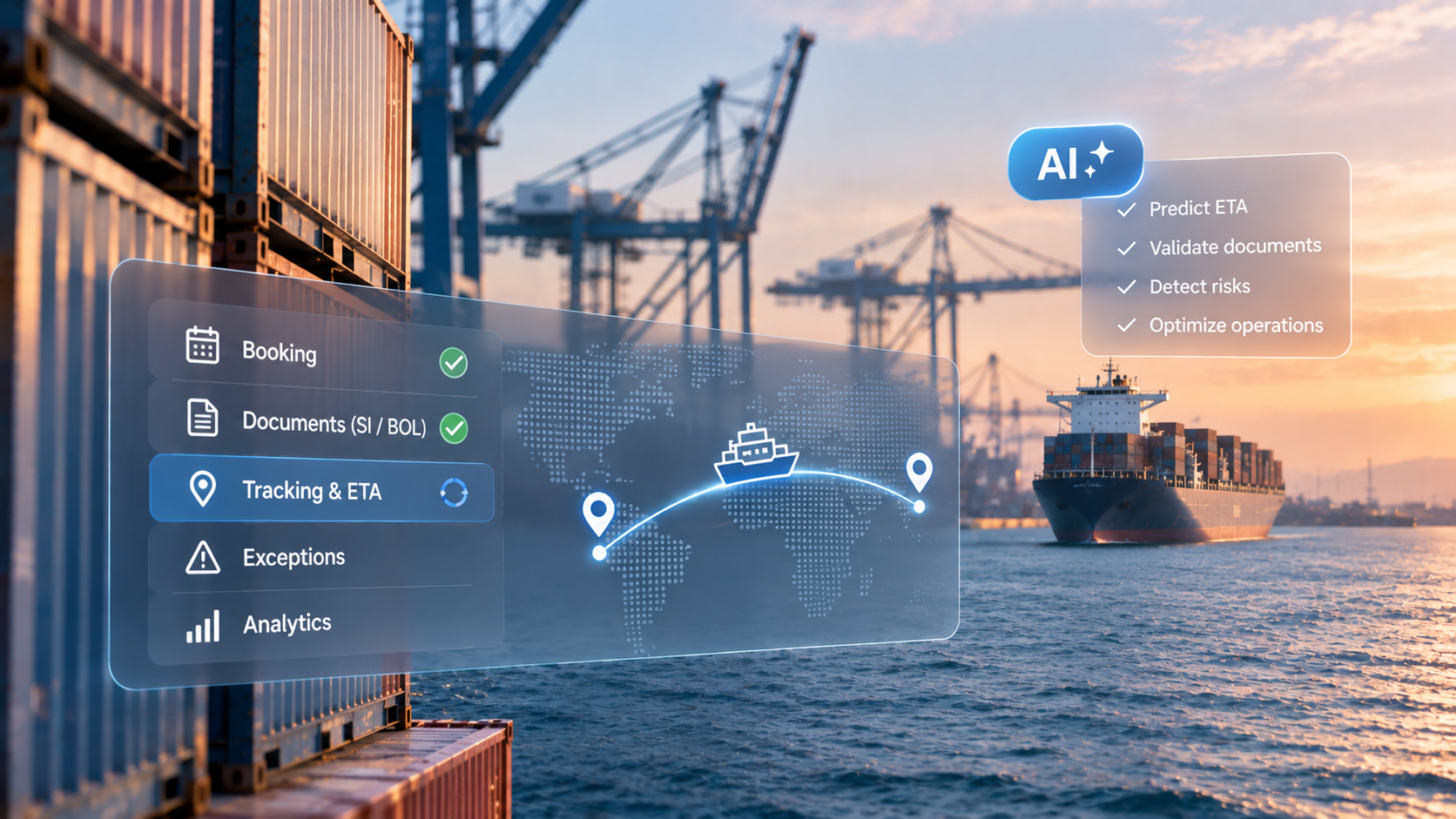
The best AI tools for ocean freight depend on the operational job your team needs to improve. Large importers managing carrier allocations and Bills of Lading need a different system from an enterprise seeking multimodal ETA data, a procurement team benchmarking contract rates, or a freight forwarder accelerating quotes.
Ocean freight involves processes that generic logistics software often does not address in enough detail:
- Vessel schedules, terminal cut-offs, and VGM deadlines
- Carrier allocations and booking confirmations
- Container, booking, and Bill of Lading milestones
- Rollovers, transshipment delays, detention, and demurrage exposure
- Shipping Instructions and Bills of Lading
- Coordination between carriers, forwarders, 3PLs, warehouses, and internal teams
The best ocean freight AI tools match the workflow causing the most manual work, cost exposure, or delay.
- BuyCo fits large-volume shippers that need ocean-specific execution, AI-assisted workflows, collaboration, and visibility in one platform.
- project44 fits enterprises seeking multimodal transportation visibility and predictive ETA data.
- FourKites fits large organizations that need predictive shipment visibility and supply chain insights.
- Flexport fits companies that want digitally managed ocean freight forwarding through a service provider.
- Freightos and cargo.one fit forwarders and commercial teams focused on rates, quotes, and booking workflows.
- Xeneta fits procurement teams that need ocean freight rate intelligence and contract benchmarking.
- NavLogic fits forwarders evaluating AI support for inbox-driven operational work.
Validate carrier coverage, regional availability, implementation requirements, integrations, data quality, and commercial terms during procurement.
What Changed in Ocean Freight AI in 2026
AI in container shipping now supports more of the work that happens around a shipment. Teams use it to structure incoming shipment data, assist with schedule selection, process documents, analyze rates, identify exceptions, and coordinate follow-up.
This shift matters because ocean freight operators rarely struggle with only one task. A delayed vessel can affect a customer delivery, a warehouse appointment, a document deadline, equipment planning, and potential detention or demurrage charges. A useful system connects the tracking signal to the people and workflows needed to respond.
Ocean freight visibility software has also expanded beyond location updates. Predictive ETA data, delay alerts, milestone confidence, and exception workflows help teams prioritize shipments that need attention. The operational benefit depends on whether the team can act from the same workspace or must move information between a visibility layer, inboxes, spreadsheets, and other systems.
Document processing is another active AI use case. Shipping teams receive shipment information through emails, PDFs, spreadsheets, invoices, Shipping Instructions, and Bills of Lading. AI can classify files, extract structured data, match documents to shipment records, and identify values that require operator review.
Forwarder-facing AI tools increasingly focus on commercial and operational workflows:
- Rate ingestion and contract extraction
- Quote preparation and margin checks
- Email parsing and request intake
- Booking handoff
- Document collection
- Exception follow-up
Buyers should distinguish between AI-assisted and autonomous workflows. A system may recommend a vessel schedule, flag a discrepancy, or draft a quote. A trained user should still approve commercial commitments, document corrections, and compliance-sensitive decisions.
Key Facts About AI in Ocean Freight
AI produces value when it improves a defined process and uses reliable shipment data.
- Predictive ETA tools combine vessel position, port congestion, and historical voyage data to estimate arrival timing and identify likely delays before a standard milestone update arrives.
- AI and predictive analytics can support route optimization, delivery-time forecasting, and disruption-risk management.
- Shipment-creation tools can turn data in emails, PDFs, and spreadsheets into structured shipment records.
- Document AI can extract fields and flag potentially missing or conflicting information before an operator approves a Shipping Instruction or draft Bill of Lading.
- Carrier-performance analysis can support allocation planning, schedule selection, and provider reviews.
- Exception workflows can help teams investigate rollovers, late milestones, missing documents, and possible avoidable charges earlier.
The most useful AI use cases connect to outcomes that teams can measure in their own operation:
- Lower manual data-entry volume
- Faster booking cycles
- Fewer document discrepancies
- Earlier response to exceptions
- Better carrier-performance analysis
- Less exposure to avoidable detention and demurrage charges
AI output quality depends on carrier connectivity, source-data quality, workflow design, and human review. Ask vendors how they handle missing, conflicting, or late carrier data. A predictive ETA or extracted document field is only useful when users understand its source and can review it before making a decision.
Quick Comparison Table: Best Ocean Freight AI Tools
| Platform | Best For | Primary AI Use Case | Core Ocean Capabilities | Pricing Approach | Key Tradeoff |
| BuyCo | Large-volume BCOs, importers, and exporters | Shipment creation, planning, document review, tracking prioritization | Booking, planning, tracking, documents, collaboration, analytics | Custom enterprise pricing | Built for substantial container-shipping operations |
| project44 | Multimodal enterprise shippers | Predictive tracking and ETA monitoring | Ocean and multimodal visibility, alerts, exception data | Custom enterprise pricing | Teams may need another system for ocean execution |
| FourKites | Large enterprises | Predictive visibility and supply chain insights | Multimodal tracking, alerts, visibility data | Custom enterprise pricing | Evaluate ocean execution requirements separately |
| Flexport | Importers and exporters seeking managed forwarding | Digital pricing, booking, and shipment management | Ocean forwarding, booking, tracking, provider-led services | Shipment-based and enterprise pricing | Includes a forwarding-service relationship |
| Freightos | Rate-focused teams and forwarders | Rate comparison, quoting, and booking | Digital rate discovery, quoting, booking | Marketplace, data products, and custom pricing | Does not replace shipper-side execution software |
| cargo.one | Freight forwarders | Contract extraction and commercial workflows | Ocean rate management, quote workflows, procurement workspace | Custom pricing | Focuses on forwarder commercial operations |
| Xeneta | Procurement-led shippers and forwarders | Contract-rate analysis and benchmarking | Ocean rate intelligence and procurement analytics | Custom pricing | Does not manage shipment execution |
| Descartes | Organizations with transport and trade-management requirements | Automation varies by selected module | Transportation, customs, routing, and trade workflows | Custom pricing | Capability depends on the modules deployed |
| CargoWise | Freight forwarders and logistics providers | Workflow and data automation | Forwarding, customs, warehouse, and transport workflows | Custom pricing | Requires process design and configuration |
| NavLogic | Ocean freight forwarders | AI support for email-driven work | Ocean-import workflow assistance | Custom pricing | Focuses on forwarder operations rather than shipper execution |
These platforms fall into distinct solution types:
- End-to-end ocean execution platforms: BuyCo
- Visibility platforms: project44 and FourKites
- Digital freight forwarders: Flexport
- Rate intelligence and procurement platforms: Xeneta
- Forwarder rate, quote, and workflow platforms: Freightos, cargo.one, CargoWise, and NavLogic
Choose an AI Tool by the Ocean Freight Job To Be Done
The best AI software for container shipping should fit how your team operates. A chatbot or reporting feature does not resolve fragmented booking processes, document backlogs, or unclear exception ownership.
| Job To Be Done | What to Evaluate | Best-Fit Platform Types |
| End-to-end ocean freight execution | Booking, carrier allocation, planning, collaboration, documentation, analytics | Ocean-specific container shipping management platforms |
| AI-powered ocean shipment tracking | Carrier data coverage, predictive ETAs, milestone quality, alerting | Visibility platforms and integrated execution platforms |
| Container booking and schedule selection | Schedule quality, cut-off data, booking workflow automation, carrier connectivity | Ocean execution platforms and digital forwarders |
| Ocean freight rate management | Contract-rate storage, rate audit, benchmarking, quote generation, margin controls | Rate management and procurement platforms |
| Bill of Lading and document compliance | Extraction accuracy, discrepancy workflows, audit trail, human approval controls | Ocean document AI and freight-forwarding workflow platforms |
| Carrier and forwarder collaboration | Shared shipment workspace, role-based tasks, messaging, performance data | Collaborative ocean freight platforms |
| Forwarder quote-to-booking automation | Rate ingestion, email parsing, quote generation, booking handoff | AI tools for freight forwarding |
| Disruption and exception management | Alert quality, operational workflows, ownership, recovery options | Integrated execution and visibility platforms |
Large shippers often need tracking data and a way to act on it. Integrated execution and visibility links delay alerts with booking records, documents, tasks, partner communication, and operational follow-up in one environment.
A tracking platform can identify a late vessel. An execution platform can also help the team assess affected bookings, update stakeholders, review documents, and coordinate next steps.
Choose by Company Type and Operating Model
| Buyer Profile | Typical Need | Best-Fit Solution Type | What to Avoid |
| Large-volume BCO / importer / exporter | Centralize complex global container operations | Ocean-specific execution platform | A tracking-only tool that leaves booking and document work fragmented |
| Enterprise shipper with multimodal network | Unified visibility data across modes | Multimodal visibility platform | Assuming a visibility provider replaces an execution system |
| Ocean freight forwarder | Faster quotes, rate management, booking, documentation | Forwarder operating system or rate and quote platform | Shipper-focused software without forwarder workflows |
| Small or occasional importer | Easy booking, tracking, support, manageable onboarding | Digital forwarder or lightweight shipment-management solution | Enterprise implementation scope that exceeds operating needs |
| Procurement-led shipper | Contract and spot-rate intelligence | Ocean freight rate management platform | Rate data without a process for allocation and booking decisions |
| Compliance-heavy shipper | Document validation and traceability | Document AI with review workflows | Fully automated document decisions without human approval |
AI container tracking software may be enough for a team whose main problem is delayed or inconsistent shipment updates. It will not automatically solve booking, allocation, document, or partner-collaboration bottlenecks.
A container-specialized TMS supports workflows built around vessel schedules, carrier bookings, container events, shipping documents, and door-to-door movement. Container-specific carrier connectivity matters because ocean teams need accurate information at the booking, container, and Bill of Lading level.
Platform Reviews
1. BuyCo: Best for End-to-End AI-Powered Ocean Freight Management
BuyCo is designed for large-volume BCOs, importers, and exporters that need to manage the full container lifecycle from one operational workspace.
The BuyCo Platform brings booking, planning, tracking, document management, collaboration, and analytics together for ocean freight teams. It supports work before departure, during transit, and after container arrival.
Core capabilities include:
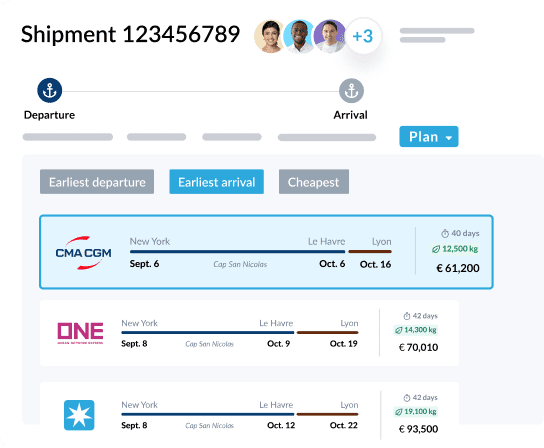
- Shipment planning and vessel schedule selection
- Carrier allocation and booking workflows
- Shipment creation from emails, PDFs, and spreadsheets
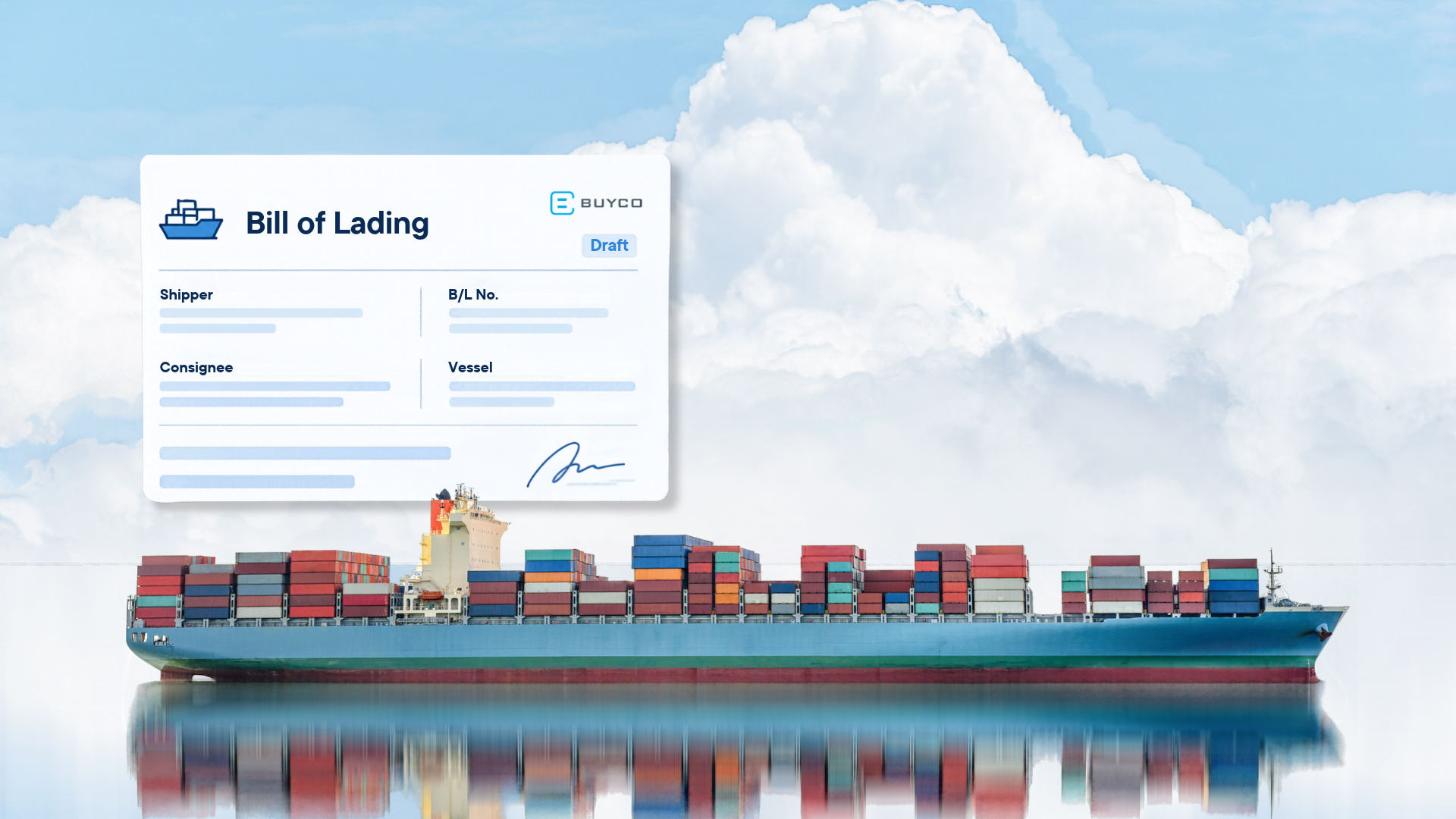
- Shipping Instruction and Bill of Lading workflows
- Door-to-door container visibility and exception management
- Collaboration with carriers, freight forwarders, 3PLs, and internal stakeholders
- Analytics for carrier performance, allocations, detention and demurrage, and emissions
BuyCo applies AI to specific container-shipping workflows rather than using broad AI claims.
- Shipment Creation AI structures unstructured shipment data from emails, PDFs, and spreadsheets.
- Planning & Booking AI supports vessel and schedule selection, booking automation, rate checks, and allocation monitoring.
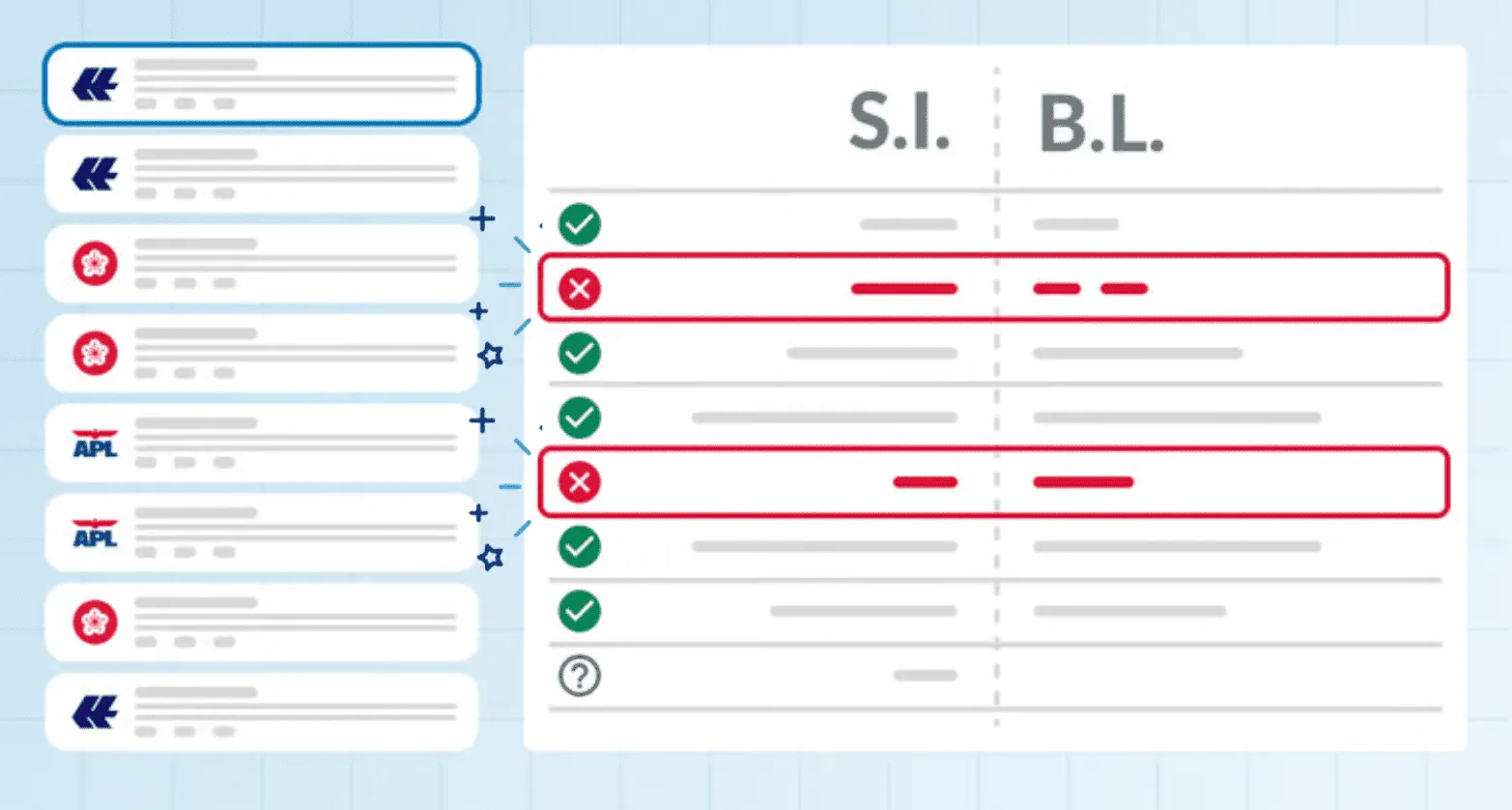
- Document Compliance AI helps audit Shipping Instructions against draft Bills of Lading.
- SmartTrack AI retrieves and prioritizes tracking information from available sources.
BuyCo AI learns from millions of real-world shipments across trade lanes and major ocean carriers. This ocean-specialized approach supports teams that need to manage vessel schedules, booking cut-offs, carrier processes, shipment documents, and exceptions at scale.
| What You Get | What to Consider |
| Ocean-specific execution across the container lifecycle | Best fit for large-volume container shippers |
| AI-assisted planning, booking, tracking, and document workflows | Validate implementation scope and integration requirements |
| Integrated visibility and partner collaboration | Confirm commercial fit for your operating model |
| API-driven integration with enterprise systems | Plan for carrier, forwarder, and internal-user adoption |
Best for: Large shippers that need AI software for ocean freight management, not only AI-powered ocean shipment tracking.
The ocean freight software comparison guide can help teams assess whether they need one operating workspace or a visibility layer connected to an existing execution stack.
2. project44: Best for Multimodal Ocean Freight Visibility
project44 is typically evaluated as a real-time transportation visibility platform for enterprises that need normalized tracking data across ocean, air, rail, truckload, LTL, and parcel movements.
Ocean freight teams may evaluate project44 for:
- Predictive ETA monitoring
- Carrier and shipment milestone tracking
- Multimodal network visibility
- Delay and exception alerts
- Data integration with existing enterprise systems
| What You Get | What to Consider |
| Visibility across multiple transport modes | Booking and allocation workflows may require another system |
| Predictive arrival monitoring | Documentation processes may sit outside the platform |
| Centralized tracking data | Validate carrier and lane coverage for your network |
| Exception alerts | Assess ERP, TMS, and operational-workflow integration needs |
Best for: Enterprises that prioritize a broad transport-visibility data layer across many modes.
project44 can strengthen an existing ocean execution environment. Buyers should confirm whether their selected configuration supports the booking, document, collaboration, and exception-response processes their team needs.
3. FourKites: Best for Enterprise Predictive Visibility and Supply Chain Insights
FourKites is an enterprise visibility platform for organizations managing complex shipment volumes across transport modes.
Ocean freight buyers should assess the following areas during evaluation:
- Ocean carrier and port milestone coverage
- Predictive ETA reliability by trade lane
- Alert configuration and exception workflows
- Integration with ERP, TMS, and customer-service processes
- Ownership assignments after a shipment alert
| What You Get | What to Consider |
| Predictive visibility and arrival insights | Evaluate execution capabilities separately |
| Configurable alerts for shipment exceptions | Confirm coverage for relevant carriers and trade lanes |
| Supply chain visibility across modes | Enterprise implementations may require integration work |
| Data for operations and customer-service teams | Check whether workflows match your ownership model |
Best for: Large retailers, manufacturers, and CPG organizations that need enterprise-scale visibility across modes.
FourKites may fit organizations that need a broad view of transport activity. Ocean-focused teams should test whether the system provides the container milestones, port events, and response workflows their operators need.
4. Flexport: Best for Digitally Managed Ocean Freight Forwarding
Flexport combines freight forwarding services with a digital platform. It is relevant for importers and exporters that want ocean procurement, booking, tracking, and shipment management through one provider relationship.
Flexport states that its ocean freight service supports digital booking, real-time container tracking, and alerts for delays and rollovers. The company also describes AI-assisted container-utilization analysis and routing recommendations.
| What You Get | What to Consider |
| Digital ocean freight procurement and booking | The solution includes a forwarding relationship |
| Container tracking and exception alerts | Carrier-neutral execution may suit some shippers better |
| Managed international logistics services | Freight pricing is generally shipment-specific |
| Container and consolidation analysis | Confirm service availability for your trade lanes |
Best for: Importers and exporters that want a digital forwarder to manage ocean shipments.
Flexport may suit companies that want a provider to execute transportation through its own service model. A carrier-neutral ocean management platform may be a better fit when a shipper wants to manage an existing network of carriers and forwarders.
5. Freightos: Best for Ocean Freight Rate Management and Digital Booking
Freightos is relevant for forwarders and logistics teams seeking digital rate comparison, quote management, and booking workflows across ocean and air freight.
Relevant workflows include:
- Ocean rate discovery
- Quote creation
- Digital booking
- Marketplace access
- Data-product access
- Forwarder rate-management processes
| What You Get | What to Consider |
| Digital rate and quote workflows | It does not replace a dedicated ocean execution platform |
| Support for booking processes | Allocation and document controls may need separate systems |
| Ocean and air commercial workflows | Confirm regional and carrier coverage |
| Marketplace and data-product options | Pricing varies by product and service |
Best for: Freight forwarders and teams focused on ocean freight rate management and booking efficiency.
Rate visibility can accelerate quoting and procurement. Shipper-side teams should also evaluate whether they need carrier allocation control, documentation, tracking, and partner collaboration after the booking is made.
6. cargo.one: Best for AI-Native Forwarder Quoting and Rate Workflows
cargo.one positions its platform for freight forwarders that need to centralize air and ocean rates, manage procurement, and create quotes faster.
The cargo.one workspace includes centralized ocean rate management, AI contract extraction, multimodal quote creation, and workflows shared between forwarder teams and AI-assisted processes.
| What You Get | What to Consider |
| Centralized air and ocean rate management | Built for forwarder commercial and procurement operations |
| AI-assisted contract extraction | Does not focus on the full shipper-side container lifecycle |
| Shared workspace for teams and partners | Validate carrier coverage and regional suitability |
| Multimodal quote workflows | Review integration requirements with existing systems |
Best for: Freight forwarders seeking AI tools for freight forwarding, especially quote and rate-management operations.
cargo.one is oriented toward forwarder sales and procurement workflows. Large BCOs that need to manage carrier allocations, bookings, documents, and container exceptions across their own provider network should assess an ocean execution platform.
7. Xeneta: Best for Ocean Freight Procurement and Contract-Rate Benchmarking
Xeneta is an ocean rate-intelligence option for shippers and forwarders that need to benchmark contracted rates, review market movement, and support procurement negotiations.
A FreightMynd comparison identifies Xeneta as a platform for contracted ocean-freight benchmarks, contract-versus-spot analysis, rate trends, and procurement analytics.
| What You Get | What to Consider |
| Contract and spot-rate analysis | Rate intelligence does not manage bookings |
| Procurement benchmarking data | Tracking and document workflows require separate tools |
| Market movement insights | Value depends on freight volume and lanes |
| Support for rate negotiations | Confirm coverage for relevant contracts and trade lanes |
Best for: Ocean-freight-heavy shippers and forwarders that need stronger rate negotiation and benchmarking data.
Rate intelligence can improve procurement decisions. Teams still need a process for translating market and contract data into allocation, booking, and carrier-management actions.
8. AI Document Automation Tools: Best for Bills of Lading, Shipping Instructions, and Data Entry
Document AI can reduce repetitive work for ocean freight teams handling large volumes of emails, PDFs, spreadsheets, Shipping Instructions, invoices, and Bills of Lading.
Useful document-AI capabilities include:
- Identifying and classifying incoming document types
- Extracting structured fields from PDFs and emails
- Matching documents to the correct shipment
- Comparing Shipping Instructions with draft Bills of Lading
- Flagging discrepancies for review
- Maintaining an audit trail of changes and approvals
Compliance-sensitive workflows require human-in-the-loop controls. AI can complete a first review and identify potential issues. Operators should retain authority over corrections, approvals, customer communication, and release decisions.
AI-assisted SI versus BL validation compares expected Shipping Instruction data with draft Bill of Lading data, flags missing or inconsistent values, and lets operators review, dismiss, investigate, or correct each issue.
Best for: Ocean freight teams whose bottleneck is manual document processing, validation, and shipment-data accuracy.
9. AI Tools for Ocean Carrier, Forwarder, and 3PL Collaboration
Ocean freight delays and errors often begin with fragmented coordination. Internal teams, carriers, forwarders, warehouses, and 3PLs may rely on separate shipment records, booking updates, emails, and document versions.
Evaluate collaboration capabilities such as:
- Shared shipment records
- Role-based tasks and exception ownership
- Booking and document status visibility
- Centralized partner communication
- Carrier and forwarder performance scorecards
- API or EDI connections with ERP, SAP, and TMS systems
Ocean freight partner management for large shippers brings carrier, forwarder, 3PL, and internal-team activities into a shared workspace. This approach gives stakeholders access to the same shipment context instead of relying on disconnected tracking portals and inboxes.
Best for: Large shippers coordinating multiple carriers, forwarders, 3PLs, and internal stakeholders.
How to Choose the Best AI Software for Ocean Freight Management
Define the Workflow You Need to Improve
Identify the process that consumes the most time, creates recurring errors, or generates the highest operational exposure.
Common ocean freight friction points include:
- Data entry from emails, spreadsheets, and PDFs
- Booking and vessel schedule selection
- Carrier allocation management
- Container tracking
- Delay response
- Bill of Lading validation
- Rate procurement
- Partner collaboration
- Reporting and carrier-performance management
A platform with strong AI-powered ocean shipment tracking may not solve booking or documentation problems. Map the process from data intake through final approval before scheduling vendor demonstrations.
Evaluate Ocean-Specific Data Coverage
Ask vendors to demonstrate data quality using your carriers, trade lanes, ports, and container types.
Verify:
- Carrier integrations and regional coverage
- Container-, booking-, and Bill-of-Lading-level tracking
- Port, terminal, and inland milestone coverage
- Data freshness and source transparency
- Predictive ETA methodology and lane-level accuracy
- Handling of missing, conflicting, or late carrier data
- Data-access methods for ERP, SAP, and TMS systems
A polished dashboard does not guarantee useful operational data. Your team needs to understand where data originates, how often it updates, and how the platform resolves conflicting events.
Check Whether AI Is Embedded in Real Workflows
Ask vendors how AI works during normal operations.
- Which workflows are automated and which are only recommended?
- Can users review and override AI output?
- Can users trace an AI decision to underlying shipment data?
- Does the system connect with ERP, SAP, TMS, EDI, and carrier processes?
- How does the platform handle exceptions, not only routine shipments?
- Who owns the decision after an alert or recommendation?
- What happens when the system cannot confidently classify a document or identify a milestone?
Chatbot functionality alone does not demonstrate operational AI maturity. Focus on whether the platform helps move shipment creation, planning, bookings, documents, and exceptions forward with clear approval controls.
Compare Total Implementation Effort
Software value depends on whether teams can operate it reliably across the container lifecycle.
Assess:
- Data onboarding and integration requirements
- Carrier, forwarder, and partner adoption
- Internal process redesign
- Training and governance
- Data-quality ownership
- License, transaction-fee, managed-service-fee, or custom-pricing models
- Resources needed to maintain integrations and workflows
The best ocean freight software is the option that your teams can operate consistently across planning, execution, visibility, documentation, and partner coordination.
Frequently Asked Questions
What are the best AI tools for ocean freight?
The best AI tools for ocean freight depend on the workflow your team needs to improve.
- BuyCo fits ocean-specific execution and AI-assisted container management.
- project44 and FourKites fit enterprise visibility and predictive tracking.
- Flexport fits digitally managed freight forwarding.
- Freightos and cargo.one fit rate, quote, and booking workflows.
- Xeneta fits procurement intelligence and contract-rate benchmarking.
Build a shortlist around the operational problem, then ask each vendor to demonstrate that workflow using real shipment scenarios from your trade lanes.
What is AI-powered ocean shipment tracking?
AI-powered ocean shipment tracking combines standard container milestones with predictive ETA models, data normalization, delay detection, and exception alerts.
Standard tracking reports milestones such as vessel departure, transshipment, discharge, and empty return. Predictive tracking estimates future timing from available operational signals. Carrier coverage, event quality, and data provenance affect the reliability of these predictions.
What is the difference between ocean freight visibility software and ocean freight management software?
Ocean freight visibility software primarily shows shipment status, location, milestones, and expected arrival. Ocean freight management software also supports planning, bookings, document workflows, partner collaboration, carrier allocation, and operational response.
Teams managing booking confirmations, Shipping Instructions, Bills of Lading, and provider allocations usually need capabilities beyond a tracking dashboard.
Can AI help reduce Bill of Lading errors?
AI can extract document fields, compare Shipping Instructions with draft Bills of Lading, and flag potential discrepancies for operator review. This reduces repetitive checking work and directs attention toward documents that need investigation.
Final document decisions should remain with trained operators because Bills of Lading carry legal, commercial, and compliance implications.
What should large shippers look for in AI container tracking software?
Large shippers should evaluate:
- Carrier coverage
- Data provenance
- Predictive ETA quality
- Alert configuration
- Container-level and shipment-level views
- API connectivity
- Exception ownership
- Integration with booking, document, and collaboration workflows
Tracking data becomes more valuable when teams have a defined process to investigate and respond to a disruption.
Is a digital freight forwarder the same as ocean freight software?
A digital freight forwarder provides managed transportation services through a technology platform. Ocean freight software may be a carrier-neutral system used to manage a shipper’s own network of carriers, forwarders, and partners.
The right model depends on whether your organization wants a provider to execute shipments or software to coordinate the providers already in use.
Conclusion: Match the AI Platform to the Ocean Freight Workflow
Choose an end-to-end ocean platform when the goal is to centralize planning, bookings, documents, collaboration, visibility, and operational response.
Choose a visibility platform when predictive tracking across a multimodal network is the main requirement. Choose a digital forwarder when transportation execution should be managed through a service provider. Choose rate and quote tools when procurement or forwarder commercial workflows are the priority.
Map the highest-cost manual workflow before beginning vendor demos. Large-volume shippers evaluating an AI-powered container shipping platform can explore BuyCo’s ocean freight software for visibility and control across container planning, execution, documents, and partner collaboration.