
Fresh produce doesn’t wait. A rolled container, a missed cut-off, or a delayed customs document isn’t just an operational headache for agricultural exporters; it’s lost shelf life, lost value, and sometimes a lost customer. Yet for many exporters, container shipping is still managed the way it was a decade ago: spreadsheets, email chains, and a rotating cast of carrier portals.
It doesn’t have to be this way. Here’s a look at why agricultural shipping is so uniquely hard to manage, and how a new operating model is helping exporters take back control.
Why Agricultural Shipping Is Different
Most companies keep shipping in-house to protect already-thin margins. That makes sense on paper, but it comes at a cost: shipping is genuinely difficult to scale. Booking, documentation, and day-to-day coordination with carriers are labor-intensive tasks that don’t get easier as volume grows; they get harder. Add in constant disruptions and shifting cut-off times, and teams are left in a permanent state of reaction rather than control.
Layer perishability on top of that, and the stakes go up considerably. Fresh products don’t tolerate uncertainty. A schedule change or a few hours of delay isn’t a footnote; it’s operational complexity that can determine whether a shipment arrives sellable at all.
Three Challenges Standing in the Way
1. The Complexity of Shipping Itself
Running container shipping well means juggling rate management, planning and scheduling, booking execution, documentation, tracking, exception handling, pre- and post-carriage logistics, performance analytics, invoicing control, and even CO2 emissions reporting, often all at once, and often across multiple carriers and geographies.
2. The Fragmentation Trap
Ask most logistics teams how many carrier portals they log into on a given day, and the answer is usually five to eight: My Maersk, My CMA CGM, My DHL, port terminal systems, and more, each with its own login and its own version of the truth. Data lives in silos across forwarders, suppliers, origin and destination teams, and customers, with cut-off dates, ETDs, ETAs, and booking numbers scattered across every one of them.
The result is what might be called “the blind spot”: an unknown change in one system becomes a costly problem by the time anyone notices it elsewhere. Teams report spending up to three times more time on manual data retrieval and entry, with some shipments consuming 20 hours of manual work each, a pace that simply cannot scale. Manual re-keying introduces errors virtually every time, and visibility across the chain drops close to zero.
3. The Ticking Clock
For agricultural exporters, the container’s journey is a race against a shelf-life clock that starts ticking the moment product leaves the farm. At the origin port, strict windows mean any delay starts eating into freshness. During ocean transit, missing a cut-off can mean cargo ripens or rots sitting in a terminal. At the destination, missing documents hold up customs clearance while the product ages further, and precise ETAs are essential for haulage to run smoothly. Add in the seasonal reality of hundreds of growers all shipping around the same harvest windows, and volume spikes compound every other pressure point.
A New Operating Model for Shipping, Powered by BuyCo
Rather than patching over these problems with more portals and more manual checks, leading exporters are moving toward a single, unified operating model built around five core stages. This is exactly the approach BuyCo has built its platform around:
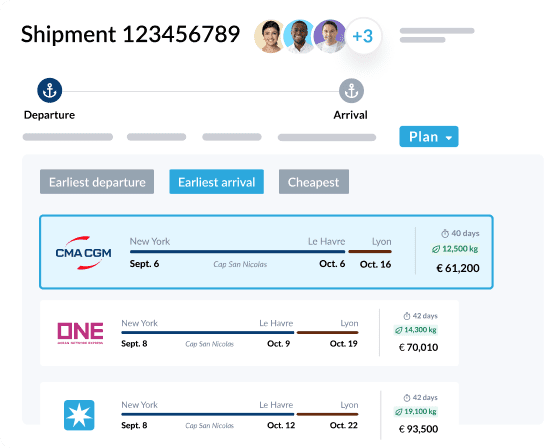
- Shipment Planning & Allocation
- Booking & Shipping Operations Execution
- Trade & Transport Documentation
- Shipment Tracking & Exception Management
- Performance & Shipping KPI Reporting
The idea is simple but powerful: one shared repository for all shipments, across all products, all countries, and all carriers, replacing the patchwork of logins and spreadsheets with a single source of truth that every stakeholder, from procurement to the warehouse floor, can see and act on in real time. In BuyCo’s platform, this looks like a single dashboard listing every shipment by carrier, route, and status, alongside a built-in messaging thread so origin and destination teams can confirm bookings, cutoffs, and documentation without leaving the platform.
The Business Impact of BuyCo
Planning gets smarter. Teams gain full control over cut-offs and departures to protect freshness, supported by ETA predictions powered by carrier and lane delay intelligence, and tighter sync with warehouse and retailer delivery commitments.
Operations get faster, with measurable savings. Digitized booking management across a network of carriers means end-to-end process efficiency, tighter control over transit and schedules, and the ability to scale volume without scaling headcount.
- Planning time cut by roughly 50%
- Shipping administrative workload reduced by about 30%, freeing teams up for higher-value work instead of paperwork
Documentation gets automated, and customs clearance speeds up. Shipping instructions, VGM declarations, certificates of origin, commercial invoices, packing lists, and export filings are generated and managed centrally, with localized workflows for different markets, removing yet another source of manual error and delay.
- 95%+ on-time document availability
- 30 to 40% faster customs clearance compared to manual processes
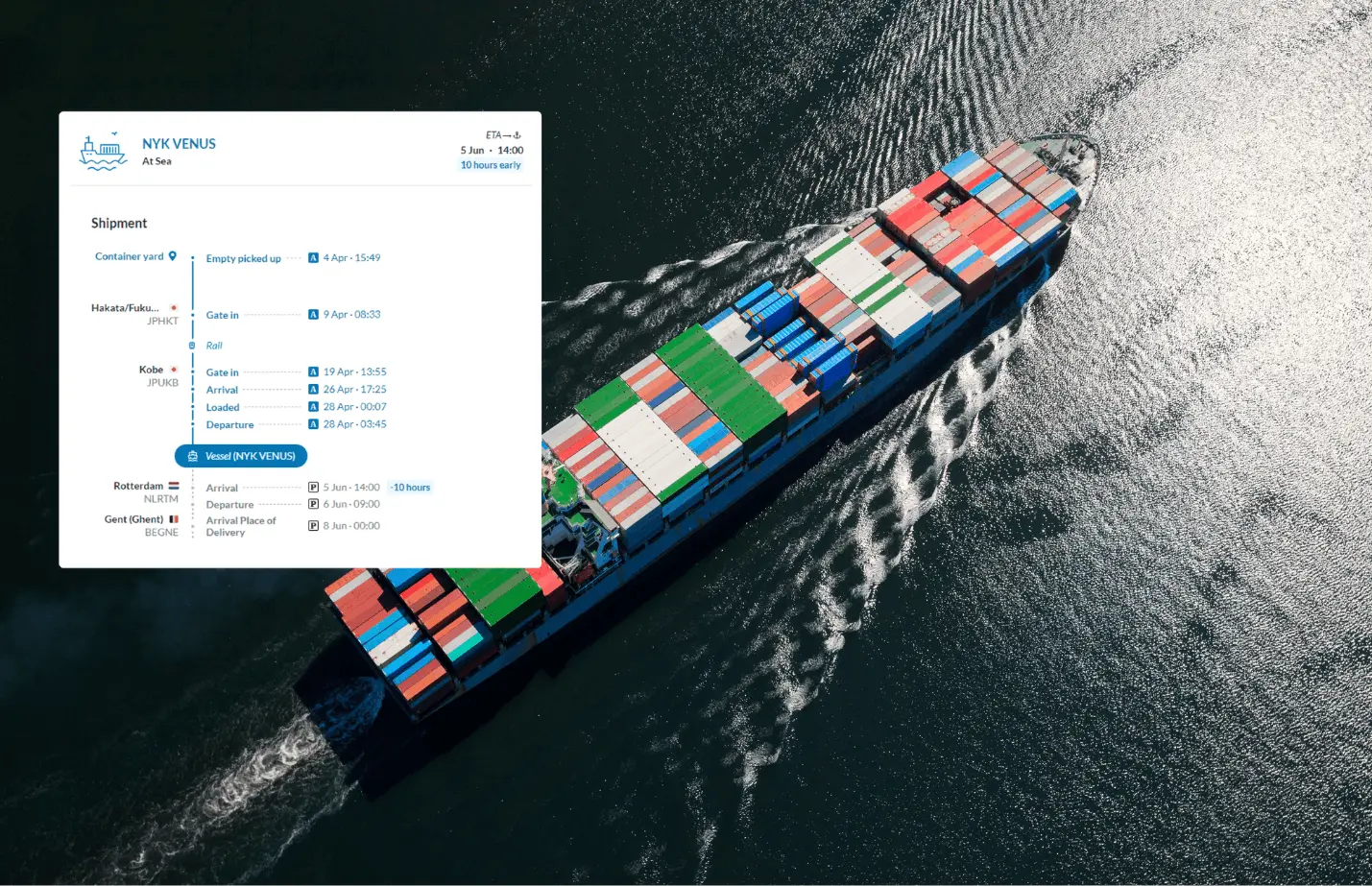
Visibility becomes universal, and it pays off in hard costs. End-to-end container tracking replaces spreadsheets entirely, giving inland and drayage teams, as well as customers, real-time visibility into where every shipment stands.
- Enhanced customer visibility, driving higher satisfaction
- Eliminated manual container tracking and the time waste that comes with it
- Streamlined haulage orchestration to protect product freshness
- Demurrage and detention costs reduced by 25 to 40%
Performance becomes measurable, and freight costs come down. With shipping data centralized, exporters can finally benchmark carrier performance, spot patterns, and negotiate from a position of data rather than guesswork. Total freight costs come down through smarter contract management, optimized allocations, and data-driven tendering.
Getting There Doesn’t Take Long
A typical rollout follows a straightforward path:
- Month 1: First bookings go live on the new system.
- Month 3: 100% of shipping volume is onboarded.
- Month 6: All container flows are fully digitized and integrated with existing ERP systems.
Conclusion
For agricultural exporters, the shift isn’t just about digitizing paperwork; it’s about closing the gap between complexity and control. With BuyCo, moving from manual spreadsheets to automated integration reduces complexity. Real-time visibility protects the “fresh” in fresh produce and keeps customers satisfied. And unifying global logistics with local distribution brings a level of orchestration that manual processes simply can’t match.
In an industry where every hour can cost value, that combination of control, visibility, and speed is what separates exporters who scale from those who stay stuck managing five browser tabs and a spreadsheet.
Interested in seeing how this works in practice? A live demo is available at buyco.co.