
For many manufacturers, retailers, and importers, inventory optimization remains one of the most important levers for improving working capital. Yet while companies invest heavily in demand forecasting, warehouse management, and replenishment strategies, one critical factor often remains overlooked: ocean transport lead time.
The reality is simple. Inventory levels are directly influenced by transportation performance. When lead times are long or unpredictable, companies compensate by increasing safety stock. While this protects product availability, it also ties up cash, increases storage costs, and reduces supply chain agility.
The challenge is that many organizations still treat ocean freight as an execution function rather than a strategic planning lever. Suppliers or freight forwarders frequently control vessel selection and routing decisions, leaving shippers with limited visibility and influence over the actual lead times of their shipments. Even when shippers retain control over booking decisions, transportation planning is often driven by required delivery dates rather than a holistic optimization of transit times.
As a result, shipments that need to arrive first are typically shipped first, regardless of whether faster or more suitable vessel options exist. This approach overlooks the significant variability in ocean schedules and transit times across carriers and services. Without the ability to systematically align vessel selection with inventory objectives, companies struggle to leverage transit time variability to their advantage. The consequence is increased lead time uncertainty, higher safety stock requirements, and excess inventory throughout the supply chain.
But what if ocean transportation lead time and uncertainty could both be reduced?
The Relationship Between Transportation Lead Time and Safety Stock
Safety stock exists to protect against uncertainty. Traditionally, inventory planners consider two major sources of uncertainty:
– Demand variability
– Supply lead time variability
While demand uncertainty is often difficult to influence, transportation lead time is far more controllable than many organizations realize. Safety stock requirements increase when:
– Average lead times are longer
– Lead times fluctuate significantly from shipment to shipment
– Arrival dates are unreliable
Conversely, reducing transportation lead time and lead time variability allows companies to operate with lower inventory levels while maintaining the same service level. In other words, transportation predictability becomes a direct contributor to inventory optimization.
Ocean Shipping Is More Variable Than Most Companies Think
A common assumption is that all carrier schedules between two ports are relatively similar. In reality, schedule variability can be significant.
Analysis of major trade lanes shows substantial differences in transit times depending on the vessel and routing selected.
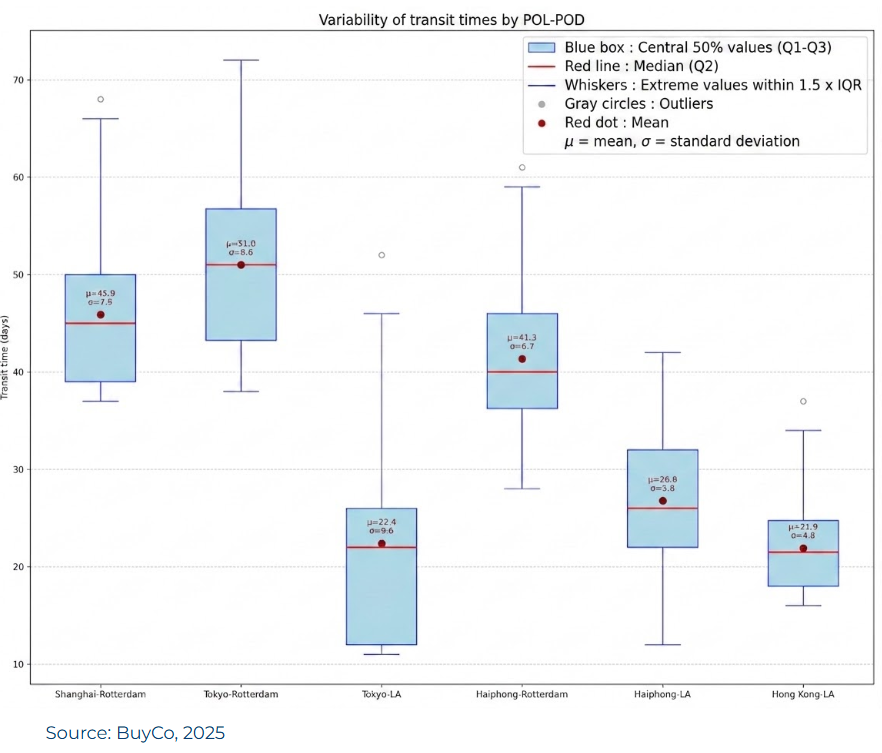
Two shipments moving between the same origin and destination can arrive days apart simply because different vessels were chosen. When these decisions are made without considering inventory requirements, companies unintentionally create additional safety stock needs.
The Inventory Cost of Poor Vessel Selection
In many organizations, vessel selection happens with little involvement from inventory or supply chain planning teams. A supplier or freight forwarder books transportation based on operational convenience, existing habits, or commercial considerations. This creates two common issues:
1. Longer Than Necessary Transit Times: The selected vessel may not offer the fastest or most suitable routing for the shipment’s required delivery date.
2. Additional ETA Buffers: To protect against delays, intermediaries often build conservative buffers into estimated arrival dates. These buffers increase uncertainty and encourage inventory planners to hold more stock than necessary.
The result is a supply chain carrying excess inventory simply because transportation decisions are disconnected from inventory objectives.
Using Vessel Selection as an Inventory Optimization Tool
Forward-thinking shippers are beginning to approach transportation planning differently. Instead of accepting whichever vessel is selected by a supplier or freight forwarder, they actively manage vessel selection according to desired delivery dates. This enables them to:
- Select shorter transit time options
- Improve ETA reliability
- Reduce lead time variability
- Increase confidence in replenishment planning
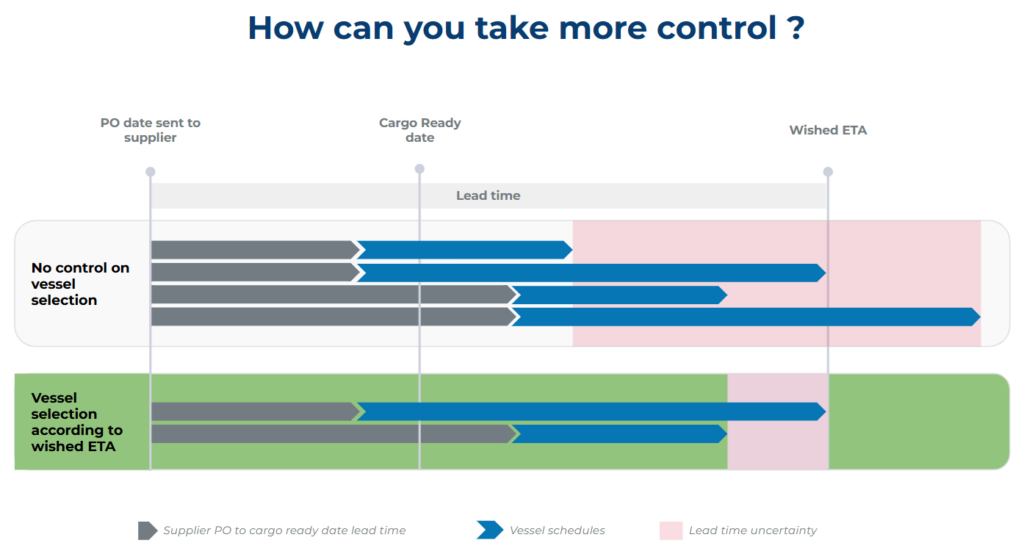
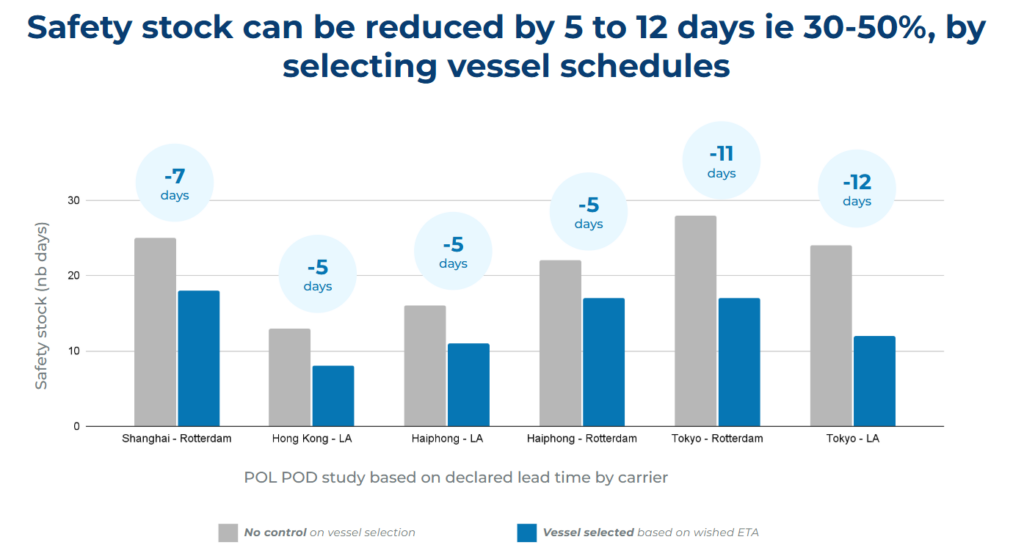
The impact can be significant. Analysis across multiple trade lanes indicates that controlling vessel selection can reduce safety stock requirements by approximately 5 to 12 days, For organizations carrying millions of euros or dollars in inventory, the resulting working capital improvements can be substantial.
Not Every Shipment Requires the Same Delivery Strategy
Another opportunity lies in recognizing that not all shipments have the same urgency. Many companies still apply identical transportation planning rules to every shipment. A more effective approach is to segment shipments according to business requirements. Examples include:
Standard Deliveries: Accept a predefined delivery window around the target date.
Urgent Deliveries: Prioritize the earliest possible arrival.
Late Delivery Acceptable: Permit later arrivals to optimize transportation costs or inventory levels.
Hard Deadline Shipments: Ensure goods never arrive after a critical date.
By matching transportation decisions to shipment priorities, companies can leverage schedule variability rather than simply protecting against it. This creates a more flexible and efficient inventory strategy.
Accurate ETA Management Is Essential
Reducing safety stock requires confidence in arrival dates. This means moving beyond static carrier schedules and incorporating actual carrier performance into planning decisions. The most effective organizations evaluate:
- Scheduled transit times
- Historical carrier delays
- Port-pair performance
- Routing reliability
- Operational KPIs
Rather than relying solely on published schedules, they use real operational data to estimate delivery dates more accurately. The result is a more reliable supply chain and less need for inventory buffers.
How BuyCo Gives Shippers Control Over Ocean Lead Times
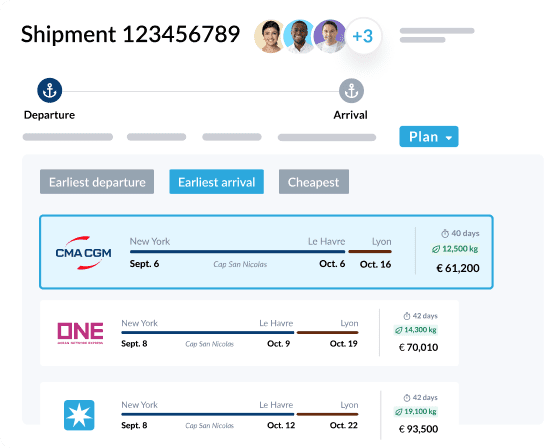
BuyCo gives shippers direct control over vessel and routing selection by integrating carrier schedules, transit times, historical carrier performance, allocations, and desired delivery dates into a single decision-making platform. Instead of relying on freight forwarders to choose the service, planners can compare available vessel options and select the one that best matches their inventory objectives, whether that means minimizing transit time, maximizing schedule reliability, or targeting a specific arrival date.
By incorporating actual carrier delay data and ETA accuracy, BuyCo enables more predictable lead times and reduces lead time uncertainty. This allows supply chain teams to move away from conservative inventory buffers, optimize safety stock levels, and improve working capital without compromising product availability.
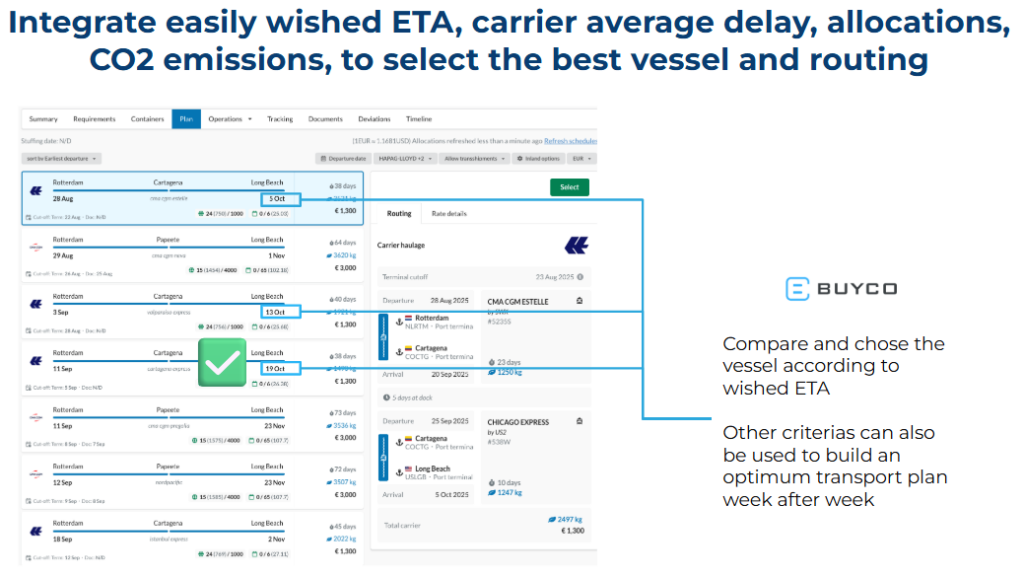
Importantly, this process can be automated within the booking workflow, ensuring that vessel optimization becomes a scalable operational practice rather than an additional task for logistics teams.
Learn more on how BuyCo helps shippers to limit safety stock.
Inventory Optimization Requires Organizational Alignment
Technology alone is not enough. To fully benefit from lead time optimization, organizations must align several functions:
Procurement: Carrier contracts should support operational flexibility and performance objectives.
Logistics Operations: Transport planners should be able to select vessels based on delivery requirements rather than default carrier choices.
Inventory Planning: Warehouse replenishment teams need visibility into reliable arrival dates.
Inland Transportation: Ocean and drayage planning should be coordinated to avoid introducing uncertainty after the vessel arrives.
When these functions operate from a shared view of shipment data and delivery expectations, inventory optimization becomes achievable.
Conclusion
For decades, safety stock has been treated as an unavoidable cost of doing business. Yet much of that inventory exists because companies lack control over transportation lead times and arrival predictability.
By taking greater control over vessel selection, measuring carrier performance, segmenting shipments according to urgency, and aligning transportation planning with inventory objectives, organizations can significantly reduce safety stock while maintaining service levels.
The companies that succeed will be those that stop viewing ocean freight as merely a transportation activity and start managing it as a strategic inventory optimization lever.
In a world where working capital, resilience, and agility matter more than ever, mastering ocean transport lead times may be one of the fastest ways to unlock hidden value across the supply chain.